1886: Anchor of a reality or seal of a fiction?
By Francisco Pérez (myztiko@gmail.com)
In April 1892, a small series of unknown stamps suddenly appeared in the American philatelic press. They were supposedly issued six years earlier by a now-defunct Central American shipping company. They were not accompanied by genuine envelopes, postal archives, or verifiable commercial documents. Instead, they came from a stamp dealer's hands: A. W. Dunning.
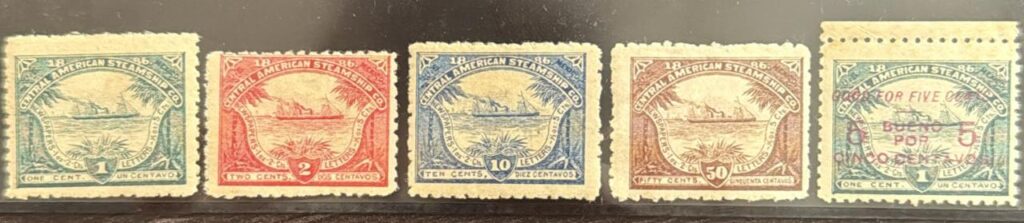
The values of this issue are: 1 cent green, 2 cents crimson, 10 cents blue, 50 cents brown, and a 5 cent surcharge over the 1 cent green.
The design of the stamp shows two steamships: the main one in the center and a secondary one to its left. Likewise, in the upper left corner, it includes the initials “U.S.,” and in the upper right corner, “México.” The stamp features the value in both numbers and letters, in English and Spanish. They were lithographed and have a perforation of 11.
This is a rather well-known issue, in new condition with gum, especially among maritime mail collectors. There are other stamps issued by shipping companies, such as the famous Lady McLeod, the stamp of the Hamburg American Packet Company, and Gauthier Frères & Cie. (1856-1857), among others.
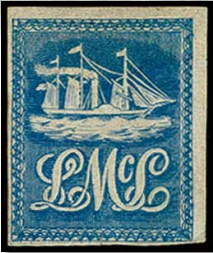
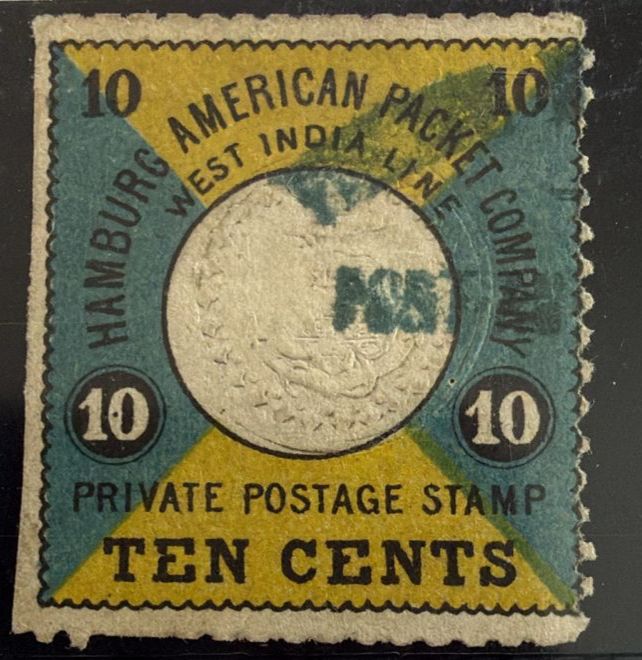
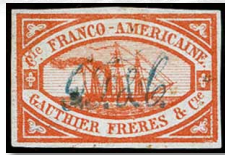
The series has been fraught with controversy since its appearance. Scott's catalog included it in the “local” category until it stopped doing so in 1916.
The series has been studied by various philatelists, who have published their theories and findings in various specialized journals. Some have limited themselves to describing the stamps of the issue, while others have attempted to determine which steamship appears in the design of the stamps, the printing house, and even the existence of the steamship company that supposedly issued it. The verdict has not been unanimous. Some have concluded that it is a Cinderella; others, that it is a false emission; and others, that it could be a genuine emission.
Marko Micanek conducted a rigorous literature review and attempts, though without reaching a definitive conclusion, to determine if the series is genuine or fake. A significant part of his analysis focuses on questioning the arguments in the article “Bringing a Bogus Issue into the Dock”, by Varro E. Tyler, who maintains that the stamps were produced by a renowned philatelic forger, Major Brewster Cox Kenyon.
Micanek's book confirms that the problem remains open. Although he seems to lean towards believing they are genuine, he makes great efforts to demonstrate that the company could have existed and places it in Boston, Massachusetts. One of the primary arguments in favor of the authenticity of the issue is the appearance of fragments with the cancellation mark “Central America S.S. Co. – SAN BLAS – 1886” on the 5-cent overprint stamp.
Before judging the nature of the emission, it is necessary to reconstruct its appearance: who presented it, when it was released, what was said about it at the time, and how the philatelic press of the era reacted.
1. The Merchant's Debut: The Suspicious Appearance of A. W. Dunning
The first documentary clue leads us to A. W. Dunning, a renowned philatelic dealer of the time. Published evidence indicates that Dunning was the one who introduced the issue into the philatelic market.
The record is important because the series does not initially appear in a circulated envelope, in a postal archive, or in the documents of a shipping company. It appears, rather, through the American philatelic press when Dunning sent two values to The American Philatelist.
The earliest known mention of this broadcast is found in The American Philatelist, in a note dated April 10, 1892. In it, William C. Stone, a writer for the magazine, indicates that he had received two copies of the issue from Dunning: a 5-cent overprint on the green 1-cent, used on a fragment of wrapper, and a new 2-cent crimson specimen.
According to information provided by Dunning, the Central American Steamship Company no longer existed and had likely been absorbed by the Pacific Mail Company. The magazine, however, did not offer a definitive conclusion. Instead, it published the information it had received and requested any additional data from its readers that could help clarify the origin of the issuance. This suggests that the magazine doubted that an issuance could go unnoticed for six years and then suddenly appear in the hands of a merchant.
Perhaps those doubts help explain A. W. Dunning's next move. A month later, in May 1892, he sent letters to several magazines, including, The American Philatelist, Mekeel, American Journal of Philately y Scott Stamp and Coin Co., from her home in Los Angeles, saying the following:
“Gentlemen, in response to your kind letter of recent date, I am sending you a copy of the letter I have in my possession from Mr. Thomas. Trusting that this will be satisfactory, I remain, Yours faithfully, A. W. Dunning”
This letter included a missive from C. H. Thomas, supposed secretary of the Central American Navigation Company, dated March 30, 1892, written on the company's letterhead. The letterhead reads literally:
Central American Steamship Co. - (Incorporated June 3, 1886) - Special Freight Rates to all Central American Ports.
The letter indicated that a Mr. Álvarez had bought the company's stamp remainders from Thomas in December of the previous year (1891). It also states that the accounting books are no longer in his possession, and therefore he cannot specify when or in what quantities the stamps were issued, but he asserts that it was in March or June of 1886.
Regarding the printing, Thomas indicates that twice as many low values were printed as high values, and that the latter were lithographed in Boston. The die was sent to the company along with the first printing. Once the company ceased to exist, the die was cleaned and sold to a printing company in Mexico City.
Regarding correspondence, Thomas says that stamps were used on letters sent on his steamships and that, if the correspondence was destined for inland cities, it should also carry country stamps.
The results of A. W. Dunning’s efforts to explain and provide evidence for the alleged origin of the issue, based on C. H. Thomas’s letter, were immediate. In 1892, the fourth edition of the Mekeel catalog included the issue for the first time, with a value of $42.50 for the set of five stamps.
This suggests that the strategy worked. Within weeks, an unknown series managed to enter the philatelic conversation and be recognized by one of the important catalogs of the time.
However, there is one detail that complicates the story. A year later, A. W. Dunning began selling the complete set of five stamps for just $5. As a result, Mekeel’s catalog reduced the value of the set to $3.50.
The question is inevitable: why would a merchant who had made such an obvious effort to get the market to accept an issue proceed shortly thereafter to drastically reduce its price?
The simplest explanation is that Dunning may have had access to a considerable number of specimens. If the issue had truly been scarce and its history solidly documented, it would not make much sense to liquidate it at a fraction of its initially assigned value. This commercial behavior does not, in itself, prove the issue is fake; but it does suggest that its entry into the market was not organic. It was pushed, explained, and legitimized by a dealer.
This brings us to the second clue: the very existence of the company.
A shipping company in the shadows: The legal labyrinth of a non-existent company
Micanek dedicates a significant portion of his research to locating the shipping company. The author found an advertisement published in The National Republican on November 28, 1885, stating that Superintendent Bell of the North American Foreign Mail Service had signed a temporary contract with the Central American Steamship Company of Boston to transport North American mail from Boston to Havana and Honduras, once a month.
The announcement stated that the shipping company promised faster delivery times than usual, and that if these conditions were met, the contract could become definitive. However, Micanek found no further mention of such a contract or of the shipping company. Nor did he find documentary evidence that a company with that name had ever been formally established, merged, acquired, or absorbed by another company.
This point is fundamental. The letter attributed to C. H. Thomas, used by Dunning to legitimize the issuance, was written on stationery from the Central American Steamship Co. The stationery literally read:
Central American Steamship Co. — Incorporated June 3, 1886 — Special Freight Rates to all Central American Ports.
The problem is apparent: Micanek's discovered postal contract announcement predates the incorporation date indicated on Thomas's letterhead by seven months. According to that letterhead, the company would have been incorporated on June 3, 1886. But the supposed temporary contract with the North American postal service would have been announced starting in November 1885.
It's not impossible for a company to operate before its formal incorporation, or for a contract to have been negotiated with an entity in the process of being established. But it's at least strange that a postal authority would sign a contract, even a temporary one, with a company that, according to its own letterhead, did not yet legally exist. That contradiction doesn't solve the mystery, but it does weaken one of the main pieces of evidence used to defend the authenticity of the issue: the letter from C. H. Thomas. If the company existed, documentation proving it still needs to be found. And if it didn't exist, then the letterhead, the letter, and the explanation transmitted by Dunning deserve much more critical examination.
At this point, it is important to make a clarification. A company with a similar name does appear in Central American sources from the 19th century. Upon reviewing Costa Rican historical databases, I found a document from February 1853 titled “Contract for Steamships between Manuel F. Carazo, on behalf of the Government, and Tomás Wright, on behalf of the Central American Steam Navigation Company.”.
Also, Roberto Gallardo, in Salvadoran Maritime Cultural Heritage: Shipwreck Registry (2016), mentions that the first commercial steamer that arrived at the Port of La Unión, in the Gulf of Fonseca, was El Primero, on January 8, 1854. According to Gallardo, it was a 225-ton ship belonging to the Central American Steam Navigation Company. The author adds that in February of that year, a contract was announced between the Government of El Salvador and the North American citizen Thomas Wright, in his capacity as representative of the shipping company. Although he clarifies that it never materialized.
However, this information should be interpreted with caution. The company mentioned in those Central American sources corresponds to the 1850s, while the philatelic issue under study is linked, according to C. H. Thomas's letter, to a company supposedly incorporated in 1886. There is more than a thirty-year difference between these two dates.
Therefore, the existence of a Central American steam navigation company in 1853-1854 does not solve the problem. Rather, it forces a distinction between two possibilities: that it represents historical antecedents of a later, as yet undocumented, company, or that the name was reused, confused, or capitalized upon to construct a narrative of legitimacy around the issuance.
If the legal existence of the company remains uncertain, the following question is inevitable: what evidentiary value do the fragments used with the stamp “Central America S.S. Co. – SAN BLAS – 1886” have?
3. The Enigma of San Blas: Evidence of Usage or Fabricated Ink?
As time went on, used copies of this series began to appear on the market. Most of them were quickly discarded as fake. This should come as no surprise. When a rare, controversial, and high-value issue enters the philatelic market without solid documentation, manufactured uses are bound to appear sooner or later.
The philatelist Richard B. Graham published an article titled “Usage of steamship stamps still a mystery”and Linn's Stamp News of July 3, 1995. In that article, Graham conducted a literature review of previous works on the emission and illustrated several well-known pieces. One of them is the only reported cover with a stamp from this series attached. It is an envelope sent from New Bedford, Massachusetts, to the first mate of the whaling ship Mary Car, with the notation “Please Forward Panama”. The envelope cost 2 cents with a North American stamp and also bears a 2-cent specimen from the Central American Steamship Company series. The latter stamp has the “Not Paid” mark in the lower left corner.
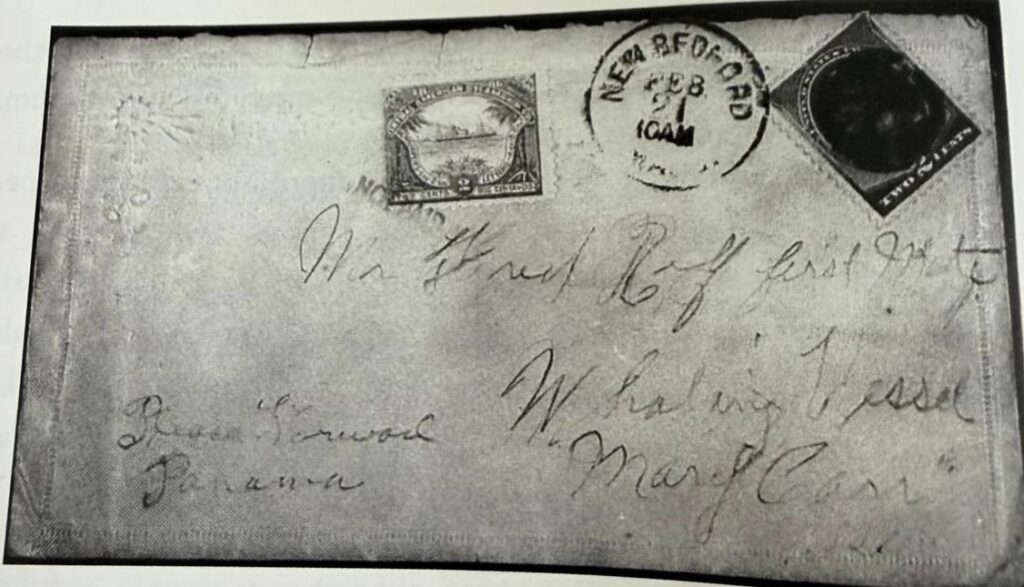
However, this cover has been considered spurious by consensus of the authors who have studied it. Therefore, although it is a striking piece, it cannot be used as proof of genuine postal use of the issue.
The San Blas postmark
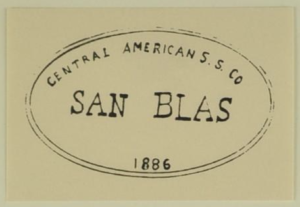
More interesting is the oval postmark with the legend “Central American S. S. Co. - San Blas - 1886”. This postmark has been considered by some scholars as the main evidence in favor of a possible genuine use of the issue.
Graham illustrates a reconstruction of the cancellation mark based on two multiple pieces: a block of four and a pair of the 5-cent surcharge on the green 1-cent stamp. The importance of these pieces lies in the fact that, together, they allow for the almost complete reconstruction of the cancellation mark's design.
Micanek also dedicates considerable attention to this point and presents a chronology of pieces reported with the San Blas postmark:
- 1892. A used fragment of the 5 cent overprint on the green 1 cent is mentioned.
- 1911. Bertram W. H. Poole mentions used stamps.
- 1965. The Williams brothers report three loose stamps with San Blas postmarks.
- 1966. A reader of the Williams brothers' article reports a four-block with a nearly complete San Blas cancellation.
- 1993. Siegel auctions the aforementioned block of four and a pair of stamps with the exact part of the cancellation missing from the block.
- 2010. Mike Sartori reports a loose stamp with a postmark.
- 2021. Corinphila offers a lot with five loose stamps and a 2-cent fragment with cancellation.
This fragment was part of the lot auctioned by Corinphila in 2021
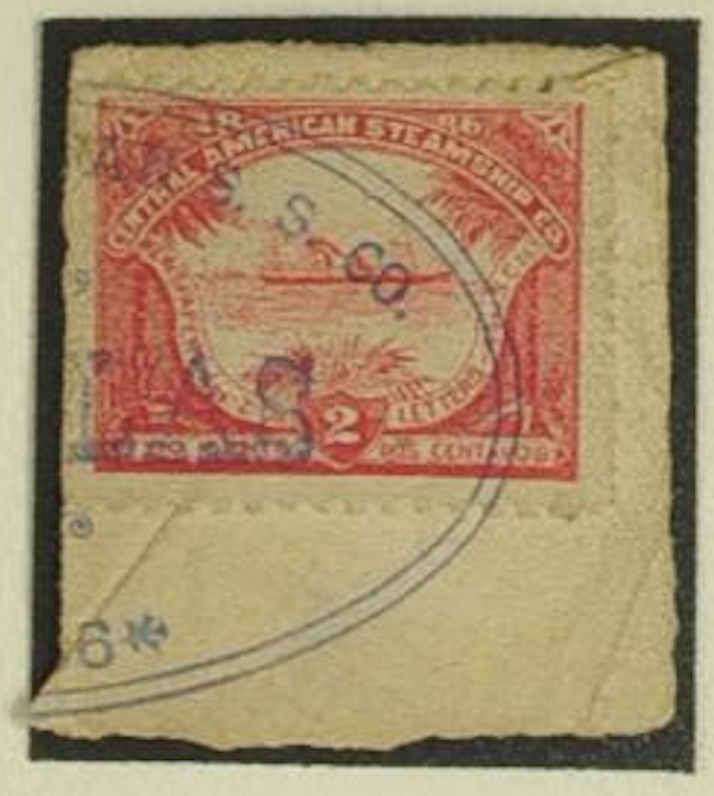
This chronology is important because it shows that the San Blas postmark is not known from a single isolated piece. Several reports exist from different times, although that alone does not solve the enigma. The repetition of the postmark can be interpreted in two ways: as evidence of actual use or as evidence that the same source produced or distributed several pieces with a mark intended to give the appearance of postal use.
Graham and Micanek also study the possible origin of the name “San Blas.” One possibility is that it refers to a port. There is a San Blas port in Nayarit, Mexico, in addition to other places with that name in the Caribbean, specifically in Cuba and Panama. However, the only one with any maritime relevance at the time appears to have been San Blas, on the Mexican Pacific coast.
The other possibility is that “San Blas” does not refer to a port, but rather to a steamship. In fact, there was an S.S. San Blas of the Pacific Mail Steamship Company. It was built in August 1882, with 1,496 net tons and 2,075 tons with cargo. It served the San Francisco-Panama-San Francisco route, with stops in Acapulco, Champerico, San José de Guatemala, Acajutla, La Libertad, La Unión, Punta Arenas, and Panama. The full journey took 48 days. The ship sank on December 18, 1901, off the coast of El Salvador, with no loss of life.
This fact opens an interesting possibility. If the name “San Blas” on the postmark refers to a steamship of the Pacific Mail Steamship Company, then the stamp would not necessarily be linked to a port, but to a vessel. But it also presents a difficulty: why would a stamp supposedly issued by the Central American Steamship Co. have been canceled with a mark that seems to allude to a Pacific Mail steamship?
The question is relevant because Dunning stated, from the first mention of the series, that the Central American Steamship Company had probably been absorbed by the Pacific Mail Company. The San Blas postmark could appear consistent with that explanation. But it could also have been constructed precisely to reinforce it.
In other words, the San Blas postmark is the strongest piece of evidence in favor of the authenticity of the issue, but also one of the most problematic. If it is genuine, it could show some type of private postal usage in 1886. If it is not, it would be a key piece of the narrative intended to legitimize the series to the philatelic market.
4. Adrift: The Geographic Contradiction of the Two Oceans
To the previous doubts is added another fundamental question: in which ocean did the Central American Steamship Co. actually operate?
The question is not insignificant. If we go by the advertisement cited by Micanek, the company would have been linked to a route from Boston to Havana and Honduras. That is, an operation in the Atlantic or the Caribbean. But if we go by the postmark of San Blas, the interpretation changes. San Blas could refer to the port of San Blas in Nayarit, Mexico, or to the steamship S.S. San Blas of the Pacific Mail Steamship Company. In both cases, the trail leads us to the Pacific.
This geographical ambiguity weakens the narrative of the issue. A real shipping company, with postal or semi-postal operations significant enough to justify a private stamp issue, should leave a clearer trace of its operating area, its routes, its steamers, its contracts, or its agents. However, in this case, indications seem to point in different directions.
If the company operated in the Pacific, the problem would be evident. The Pacific Mail Steamship Company already operated on that coast, a well-established company with regular routes and extensive experience in transporting passengers, cargo, and mail between San Francisco, Mexico, Central America, and Panama. In that context, it is not easy to explain why a smaller company, whose existence has not yet been documented, would have needed to issue private stamps to handle mail outside of the pouch, especially if a functional maritime and postal network already existed.
If, on the contrary, the company operated in the Caribbean or the Atlantic, the problem would not disappear either. In that zone, there were also established shipping companies that provided regular services, such as the Royal Mail and the Hamburg-Amerika-Linie, among others. Furthermore, a good part of the non-baggage mail related to steamers and international routes was processed through established postal channels, especially in New York. If the Central American Steamship Co. truly provided a private or complementary postal service, some trace of that use would be expected: envelopes, transit marks, agent cancellations, references in the commercial press, or documents linked to foreign postal officials.
So far, that evidence does not seem to exist. In any case, no genuine cover from the issue used under conditions allowing for the reconstruction of a complete postal route is known. Nor are there known pieces with foreign post office cancellations supporting the existence of a regular service. What does exist is a small group of fragments with a postmark that, while striking, remains difficult to place within a specific maritime operation.
Therefore, the question about the ocean is not a minor detail. If experts cannot agree on whether the company operated in the Pacific or the Caribbean, then the basic piece of information needed to understand the postal logic of the issuance is still missing. In this case, the route is uncertain, the service is undocumented, and the postal necessity has not been convincingly explained. All of the above becomes even more problematic when considering the postal context of the era. Thomas C. Jefferies, in describing the New York General Post Office, points out that foreign mail arrived primarily by steamship, with New York serving as a transit or destination port, although it could also enter through Boston, Philadelphia, Key West, New Orleans, Laredo, San Francisco, Seattle, and Vancouver. In other words, the North American postal system already had several entry points and an organized structure for processing international correspondence.
Jefferies also mentions that a significant portion of that correspondence arrived either without full postage or only partially paid, and that the postal system was responsible for calculating and collecting the corresponding fees. This detail is key. If international sea mail already had formal channels for receiving, distributing, and collecting insufficiently franked mail, the practical need for a private issue like that of the Central American Steamship Co. becomes even less clear.
In other words, the problem isn't solely that we don't know whether the company operated in the Pacific or the Caribbean. The problem is that, in either scenario, there was already a postal infrastructure capable of handling international maritime correspondence. Therefore, the absence of genuine envelopes, transit marks, identifiable agents, business records, or operational evidence is not merely a documentary void. It's an absence that's difficult to reconcile with a company that supposedly had the need to issue its own stamps.
A private stamp from a shipping company requires a route, a service, an operational need, and evidence of use. In this case, the route is uncertain, the service is undocumented, and the postal need is increasingly difficult to explain.
5. The Master's Shadow: The Hand of Brewster Cox Kenyon (alias Kenyon Brewster Cox)
The research of philatelist Varro E. Tyler, presented in his article “Bringing a Bogus Issue into the Dock” (1985) directly points to a central figure: Brewster Cox Kenyon (alias Kenyon Brewster Cox). This character was no amateur; he was a multifaceted man: a stamp dealer, auctioneer, major, and paymaster of the U.S. Volunteer Corps, who had mastered the art of market manipulation.
The first warning sign regarding his possible connection to the 1886 series comes from an 1898 chronicle written by W. Sellschopp. In it, the editor recounted how a “large batch” of Central American Steamship Co. labels had been “unearthed” in Los Angeles, calling the find an economic success for “someone else,” clearly alluding to illicit profit.
Kenyon's reputation as a systematic forger is widely documented:
- A born forger: Christopher G. Harman argues that Kenyon was willing to manufacture and sell completely false emissions throughout his life.
- A resume of infamy David Beech, in his work Grinnell Missionaries, identifies him as the mastermind behind the counterfeiting of the “Hawaii Missionaries” and the famous 1869 ninety-cent "Inverted Centers.".
- The technical detail: Kenyon is known to have gone as far as attempting to purchase the specific paper used in original Hawaiian emissions to perfect his forgeries.
- Diversity of fields His “operation” knew no bounds, encompassing everything from State Department seals to tax records and Confederate emissions.
Kenyon possessed the technical ability, the necessary contacts, and, above all, the willingness to produce unauthorized philatelic material designed to entice collectors in the late 19th century. His profile fits with astonishing precision the type of “mastermind” capable of orchestrating such an exotic and difficult-to-verify issue as that of the Central American Steamship Company.
There is a work by Kenyon that is of particular interest for this analysis: the creation, in 1898, of the unauthorized series known as Army Frank.
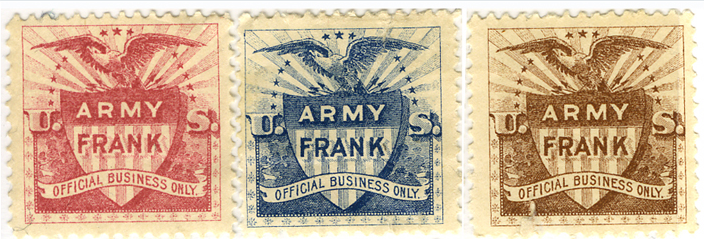
As is notorious, these stamps have no face value and their purpose was to be used on official military correspondence. Both the army and the postal service rejected the stamps as spurious, and it was confirmed that the design and production were carried out by Major Brewster C. Kenyon in 1898. Although it was advertised as suitable for use during the Spanish-American War, it was never authorized by the Army or the Post Office Department.
During the research for this article, I noticed a color similarity between some values in the Army Frank from 1898 and those of the Central American Steamship Company series. The observation is necessarily circumstantial: a comparison of colors is not enough to attribute an issue. However, the parallel recalls something important for this analysis: Kenyon had the technical ability, contacts, and willingness to produce unauthorized philatelic material intended for the collector's market.
The question, then, is not whether this evidence proves Kenyon produced the series. It does not. The question is more limited, but equally relevant: does Kenyon fit the profile of a person who could have been behind such a broadcast? The answer appears to be yes.
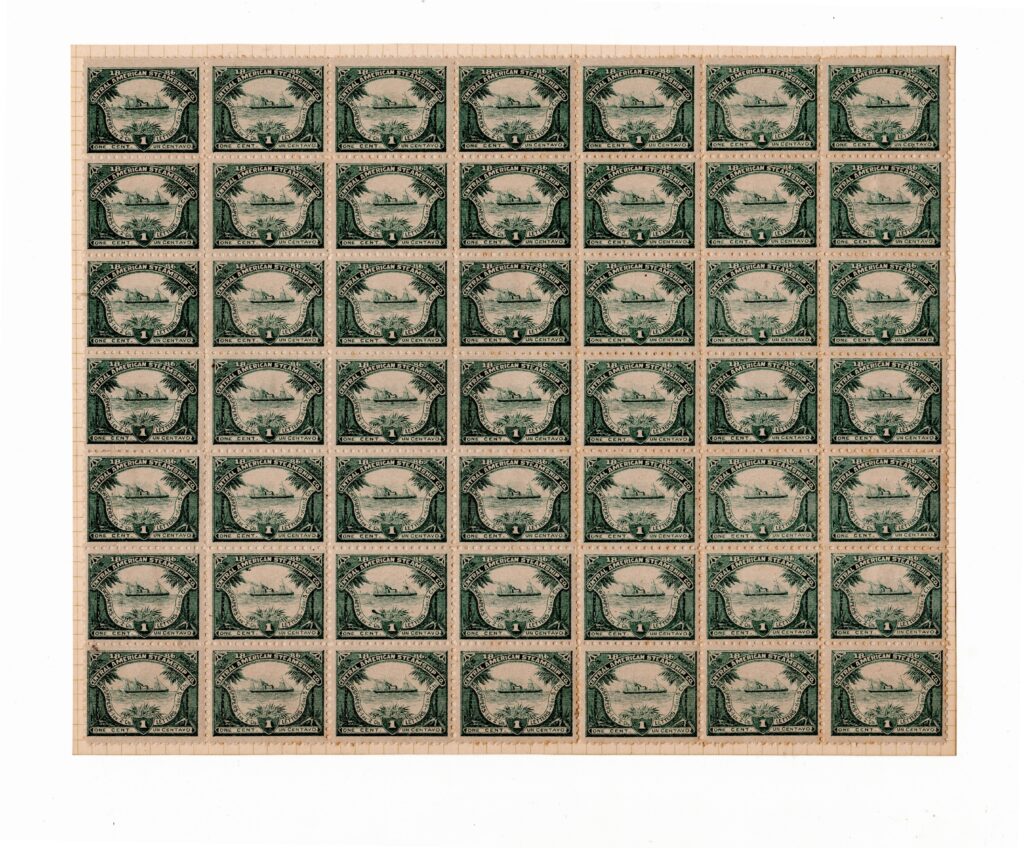
Pieza múltiple de 49 sellos del 1 centavo verde, que en apariencia, nunca fue puesto en venta
Pieza múltiple de 49 sellos de la sobrecarga de 5 centavos en rojo sobre el 1 centavo verde. La gran mayoría de las piezas “usadas” llevan este sello.
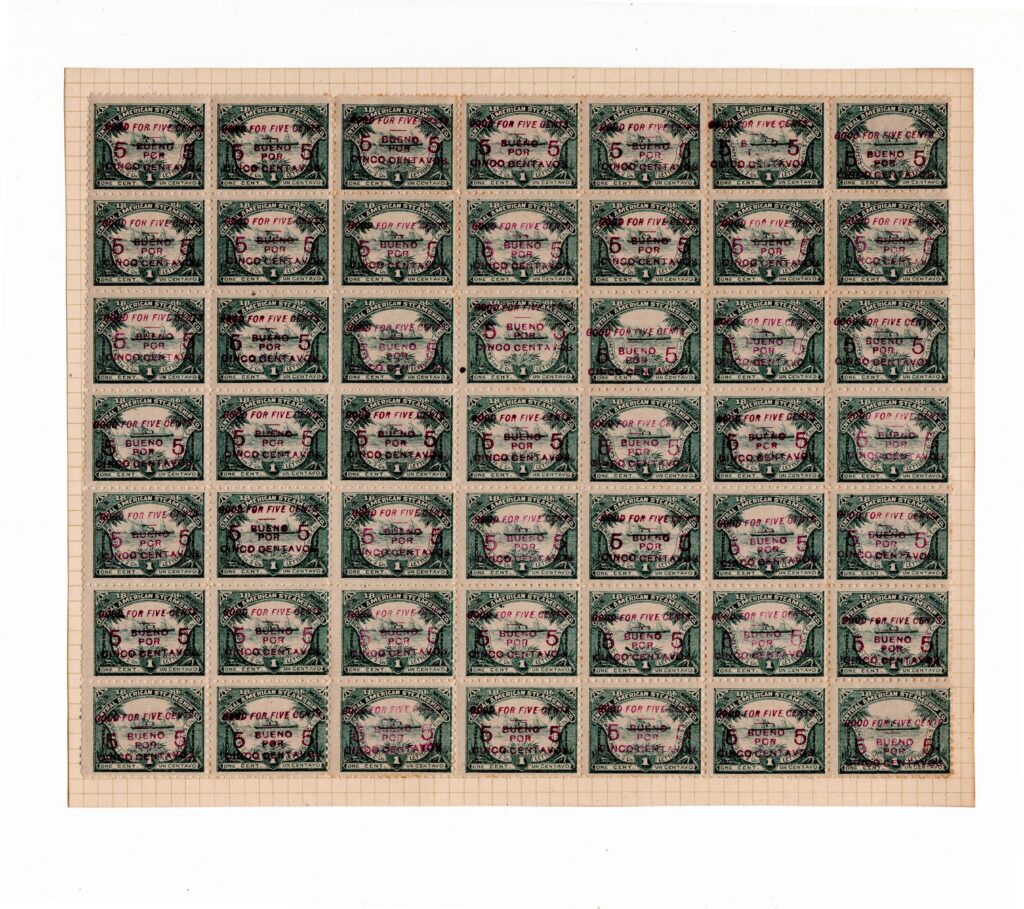
Estas dos imágenes ayudan a validar el relato de que las estampillas de esta serie fueron impresas en pliegos de 98 estampillas.
6. Neighbors in California: The Nexus Between the “Creator” and the Seller
Although no author seems to have demonstrated a direct relationship between Brewster Cox Kenyon and A. W. Dunning, there is at least a temporal and spatial nexus that deserves attention. Both were contemporaries and in California in the early 1890s: Kenyon in Long Beach and Dunning in Los Angeles.
Image taken from the US philatelist directory
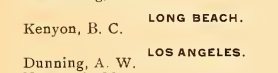
This piece of data, by itself, does not prove any collaboration. However, it is suggestive within the context of the circumstances surrounding the appearance of the issue. The series did not appear in a postal archive or in commercial correspondence clearly linked to the company. It appeared in the hands of a philatelic dealer in California, accompanied by an explanatory letter and a story intended to justify its origin.
Kenyon's possible involvement should therefore not be understood as a closed conclusion, but as a hypothesis compatible with some elements of the case: his track record as a producer of spurious philatelic material, his presence in California, Sellschopp's early mention of the Central American Steamship Co. labels, and the subsequent appearance of other unauthorized issues associated with his name.
This hypothesis doesn't solve the case, but it changes the angle of analysis. If the emission cannot be clearly explained by the postal operations of a shipping company, then the possibility must also be considered that it arose from the philatelic market itself: as a piece designed, narrated, and distributed to satisfy collectors' interest in rare, local, or private issues.
The 1886 anchor: Foundation of truth or architect of a fiction?
After reviewing the series' market appearance, A.W. Dunning's performance, the uncertain legal existence of the Central American Steamship Co., the fragments with the San Blas postmark, the ambiguity about its operating area, and the potential shadow of Brewster Cox Kenyon, there is a common thread running through the entire mystery: the year 1886.
That year it appears, first, on the stamps, as well as on the letterhead of the letter attributed to C. H. Thomas, where it is stated that the company was incorporated on June 3, 1886. It also appears on the same letter, when Thomas indicates that the stamps would have been issued in March or June of that year. And it appears, finally, on the oval postmark of San Blas, with the legend “Central American S. S. Co. – San Blas – 1886”.
At first glance, the repetition of 1886 could be interpreted as a sign of consistency. But it can also be read another way: as the year around which the entire narrative of the issue's legitimacy was constructed.
The matter is not trivial. If the company was incorporated on June 3, 1886, it is difficult to unreservedly accept that the stamps were issued in March, April, or May of that same year. For that to have happened, a company that did not yet legally exist would have had to order, approve, receive, and put into circulation a private issue before its own incorporation.
Even the possibility of June raises questions. If the incorporation occurred on June 3rd, it would need to be explained how, within a matter of days or weeks, the company was able to organize the printing of the stamps, receive them, distribute them, use them in correspondence, and generate postmarked pieces. It's not impossible, but it does require documentary evidence that, so far, doesn't seem to have appeared.
Therefore, 1886 should not be seen as just a reiterated date. It is a central piece of the problem. If that year is correct, there should be some documentary trace to support it: incorporation records, postal contracts, commercial advertisements, steamer lists, company correspondence, or reliably dated postal evidence.
The absence of this documentation does not, in itself, prove that the issue is false. But it does require caution. The history of the Central American Steamship Company rests, to a large extent, on documents and stamps that reinforce each other, but which do not appear to be supported by sufficient external evidence.
This lack of documentation is compounded by an operational problem. If the company operated in the Pacific, it did so in an environment where the Pacific Mail Steamship Company already offered established routes and an operational mail transport network. If it operated in the Caribbean or the Atlantic, there were also established shipping companies and postal channels capable of processing international mail. In either scenario, the practical need for a private issue remains unclear.
The possible shadow of Brewster Cox Kenyon does not prove the falsity of the issue, but it does reinforce the need to examine it with caution. His profile fits the type of actor who could have understood the commercial value of an exotic issue, difficult to verify and attractive to the philatelic market of the late 19th century. In that sense, the initial question remains open: who was behind the 1886 Central American Steamship Company issue? What does seem clear is that the issue did not enter the philatelic world as a fully documented postal issue. It entered through a dealer, accompanied by an explanatory letter, was temporarily accepted by some catalogs, and has been sustained to this day by a small group of items whose probative value remains debatable.
Perhaps that's why, more than 130 years later, this series retains its appeal. Not just because of its colors or its rarity, but also because it continues to pose an uncomfortable question: if 1886 is the key to the mystery, is it the proof that confirms the authenticity of the issue or, on the contrary, the most revealing clue of a story constructed to give it legitimacy?
References
- Micanek, M. (2022). The Central American Steamship Company (2nd ed.). Author's edition.
- Tyler, V. E. 1985. Bringing a bogus issue into the dock: Central American Steamship Co. Stamps. The American Philatelist, 919-921.
- Graham, R. B. (July 3, 1995). Usage of steamship stamps still a mystery. Linn's Stamp News.
- Gallardo, R. (2016). El Salvador's Maritime Cultural Heritage: Shipwreck Registry. UNESCO; Secretariat of Culture of the Presidency.
- Harman, C. G. April 24, 1997. Fakes, forgeries, and their creators [Exhibition Brochure]. The Royal Philatelic Society London.
- Beech, D. (2003). The Grinnell Missionaries. Mystic Stamp Company.
- Jefferies, T. C. (1922). The postal system of the United States and the New York General Post Office. Manufacturers Trust Company.
