Nocturnal Philatelic Hallucinations: My Reunion with Stamps
By David Pérez Camacho (david@arabicaconsulting.com)
The beginnings
I started collecting stamps when I was twelve years old, around the year 2000. Mentors, family, and friends gave me first-day covers, regular envelopes, and all sorts of stamps with very interesting designs. I spent hours learning how to separate stamps from envelopes and cataloging, in small plastic bags, the stamps and envelopes I had by country, mainly from Latin American countries.
That “collection,” a hyperbolic term, was stored away for 26 years until I reconnected with philately this year.
Uses and Abuses of Technology in Philatelic Knowledge
In addition to my original collection, I recently acquired more serious and interesting material, mainly classic stamps from Peru, Brazil, Spain, and Sweden. With limited time, my particular interest at the moment has been studying and cataloging the first two collections, and I've found it very rewarding to discover groups like the Peru Philatelic Study Circle, which has digitized a large part of Peruvian philatelic heritage and research, and online resources like the Mi Oficina YouTube channel.
That said, impatience gets the better of me, and in the age of artificial intelligence, I admit that every now and then I simply take photos of the stamps I find most interesting and upload them to one of the many AI tools currently available to see what I can find. I mentioned this to my brother, the editor of Timbre, and, frowning, he sent me off with some print issues of Timbre magazine and catalogs and serious research books.
George V, the Silver Jubilee, and the unknown profile
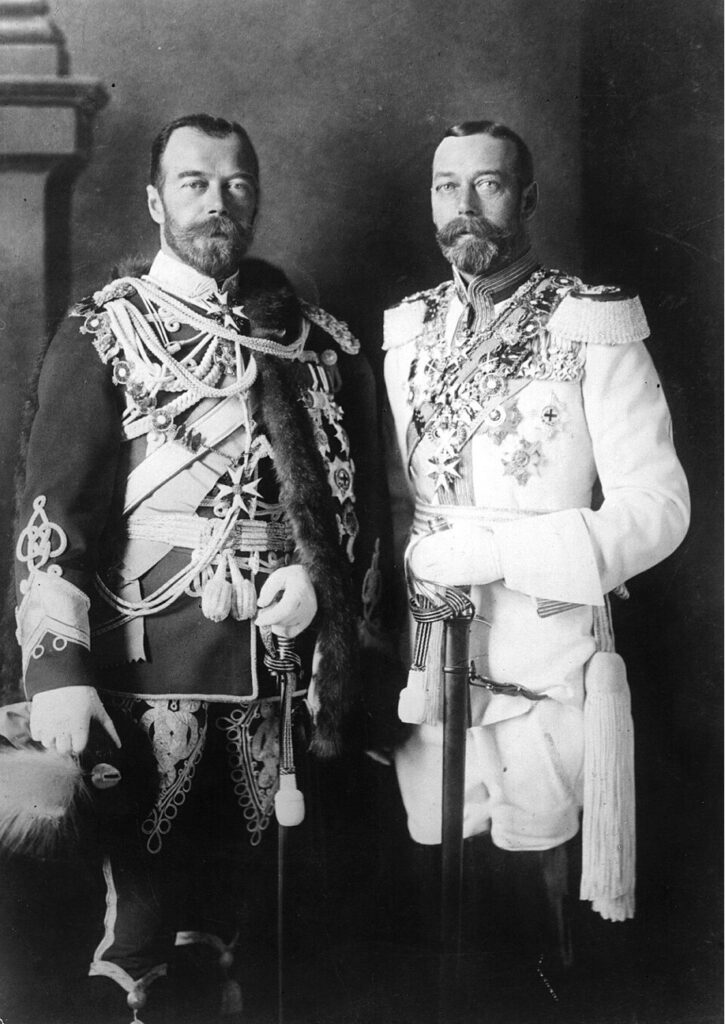
Photograph of George V of the United Kingdom (right) and Nicholas II of Russia (left), both wearing German military uniforms, May 1913. George V and Nicholas II were cousins, and both were also cousins of Wilhelm II of Germany.
During one of my recent late-night philatelic study sessions, I reviewed a bag from my childhood collection and found some British stamps commemorating the 1935 Silver Jubilee, which celebrated the 25th anniversary of the reign of British monarch George V—who, incidentally, was an accomplished philatelist and known as the Collector King.
These stamps measure 40 x 24 mm and have a perforation of 14 ½ x 14 ¼.
The original series consists of four stamps (of which I have all but the first):
Half a penny, in green,
A penny, in red,
Three halfpence, in coffee, and
Two and a half pennies, in blue.
The most striking feature of my stamps is the perfin (from the English PERforated INitials or PERforated INsignia) seen on the two-and-a-half-pence blue stamp, with the letters AL (the A with 10 holes and the L with 7 holes).
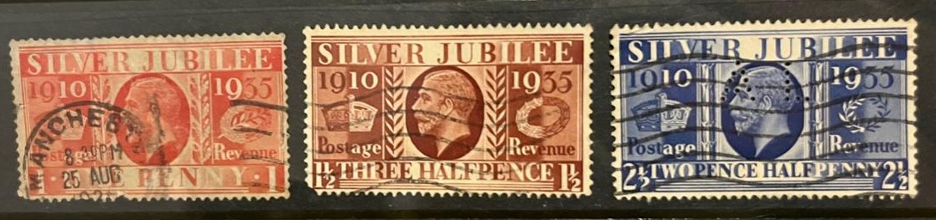
My Silver Jubilee stamps, on the right is the two and a half pence stamp with the AL perfins in the center.
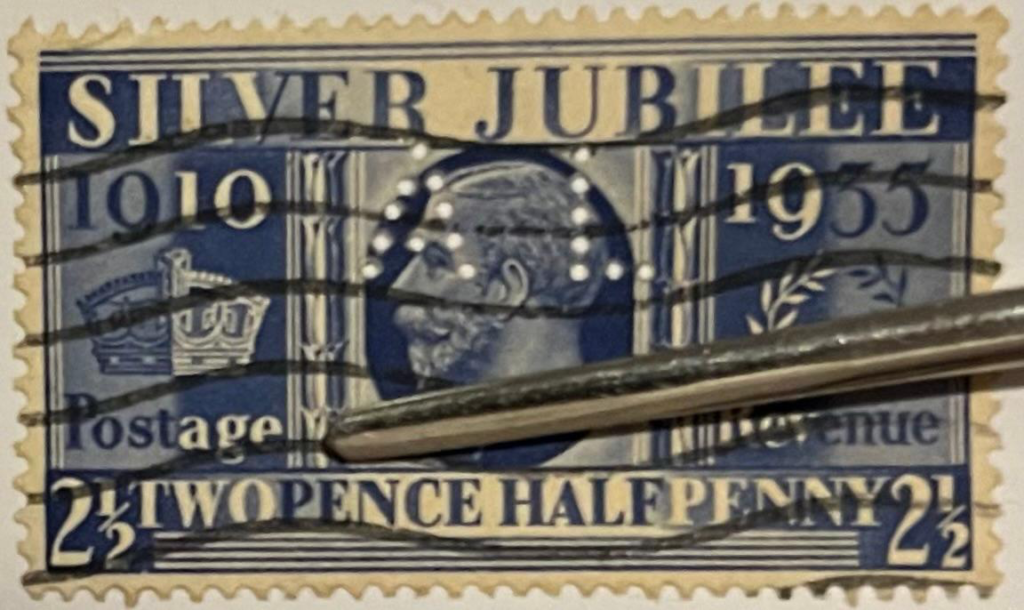
Image of my seal with better contrast to appreciate the profile.
Intrigued by this “oddity,” I took a picture of the set and uploaded it to an artificial intelligence to see if it could explain more about the “AL” perfin. The answer I received was generic, but it did point me to The Perfin Society, a British organization founded in 1957 that is dedicated to studying and cataloging this philatelic phenomenon of perforating stamps with specific hole patterns. The original purpose of perfins, developed in Great Britain in 1868, was to prevent employees from stealing stamps that their employers bought in large quantities.
Artificial intelligence encouraged me to write to The Perfin Society, but it added an unexpected bonus that diverted me from my original interest: the two-and-a-half pence blue stamp has one of the most iconic color errors in British philately, and it was likely I had one in my possession.
Prussian blue error
It appears that Harrison & Son, the printing company responsible for these stamps, mistakenly printed several runs of the two-and-a-half pence stamp in a Prussian blue or turquoise color, which were part of the original trials but did not receive the king's final approval, as he chose navy blue.
Upon realizing the error, the printing office destroyed all existing copies, except for six sheets that had already been sent for inspection to the Post Office shops. Subsequently, the superintendency ordered the destruction of the six remaining sheets, while retaining a block of four stamps for reference. Only two sheets were destroyed, and it appears the other four were inadvertently placed with other navy blue sheets by a distracted employee. Three sheets ended up at the Edmonton Post Office, north of London, and the whereabouts of the remaining sheet are unknown.
Ultimately, only 480 of these Prussian blue two-and-a-half-penny stamps were issued and likely used. For reference, a single copy is currently on sale for $20,000 (15,000 pounds sterling).
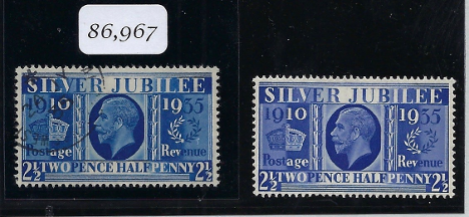
Image found on the internet showing Prussian blue (left) and navy blue (right)
Mystery solved
I won't lie. I spent until midnight looking for comparisons between navy blue and Prussian blue, and sometimes I thought I found them and other times I felt like fate was toying with me. Ironically, artificial intelligence made me hallucinate. I finally realized that the version I had was navy blue because Prussian blue has shades of turquoise green that, no matter how hard I tried, I couldn't spot.
In a last, desperate attempt, I wrote an email to The Perfin Society asking about the AL perforation on my stamp, harboring the secret hope that they would tell me I had the now very important two-and-a-half pence, Prussian blue stamp. With tired eyes, I looked at the clock, which read 12:07 am in Costa Rica (7:07 am in England), and after rereading the email, I clicked “Send.”.
Upon waking, around 7:00 am, I picked up my phone and saw that I had received a reply. Without much fanfare, they explained that I had used an obsolete catalog; they offered me membership in The Perfin Society and suggested I purchase the updated catalog. They kindly explained that I was fortunate, as the AL perfin is identified and was used by Anchor Line Ltd, a Scottish shipping company that operated from 1855 to 1980. They didn't even mention Prussian blue.
References
Hall, Mike. “The King's Error.” JustCollecting. June 27, 2022. https://www.justcollecting.com/blogs/news/the-king-s-error.
Paul Fraser Collectibles. “Great Britain 1935 2½d Prussian Blue, SG456a.” Accessed May 5, 2026. https://www.paulfrasercollectibles.com/products/great-britain-1935-2-1-2d-prussian-blue-sg456a-1.
The Postal Museum. “Silver Jubilee.” Accessed May 5, 2026. https://www.postalmuseum.org/collections/highlights/philatelic-collection/british-stamps/george-v-stamps/silver-jubilee/.
The Postal Museum. “Stamp History: 1935 Silver Jubilee.” PDF. December 2018. https://www.postalmuseum.org/wp-content/uploads/2018/12/Stamp-History-1935-Silver-Jubilee.pdf.
The Perfin Society. “Home.” Accessed May 5, 2026. https://perfinsoc.org.uk/.
