Álvaro Castro-Harrigan
Civil wars in Central America
On November 17, 1983, President Luis Alberto Monge proclaimed to the world that Costa Rica was living a “perpetual, active and unarmed neutrality”.
This proclamation was made in the midst of civil wars, following the overthrow of dictator Anastasio Somoza by the Sandinista Army, which came to power in Nicaragua.
The Central Intelligence Agency (CIA) of the United States transferred resources to the so-called Nicaraguan Contra, through John Hull, a member of the CIA.
This individual used a clandestine airport to transport the supplies from Costa Rica. President Reagan supposedly wanted to destabilize the Nicaraguan government in this way.
It was then that President Monge emphasized that Costa Rica was a country of peace and that, in view of the situation in Nicaragua, “we declare ourselves in perpetual neutrality”. More than 30 years had passed since then.
Peace Proclamation Act
In November 2014, the Legislative Assembly, in its Committee with Full Power III, approved Bill No. 17944, called Law for the Proclamation of Peace as a Human Right and of Costa Rica as a neutral country.
The law establishes that, in the event of any international armed conflict or crisis within the States, the country must adopt a neutral, perpetual, active and unarmed position. It also obliges the State to incorporate content that promotes a culture of peace in its educational programs.
Philatelic aspects
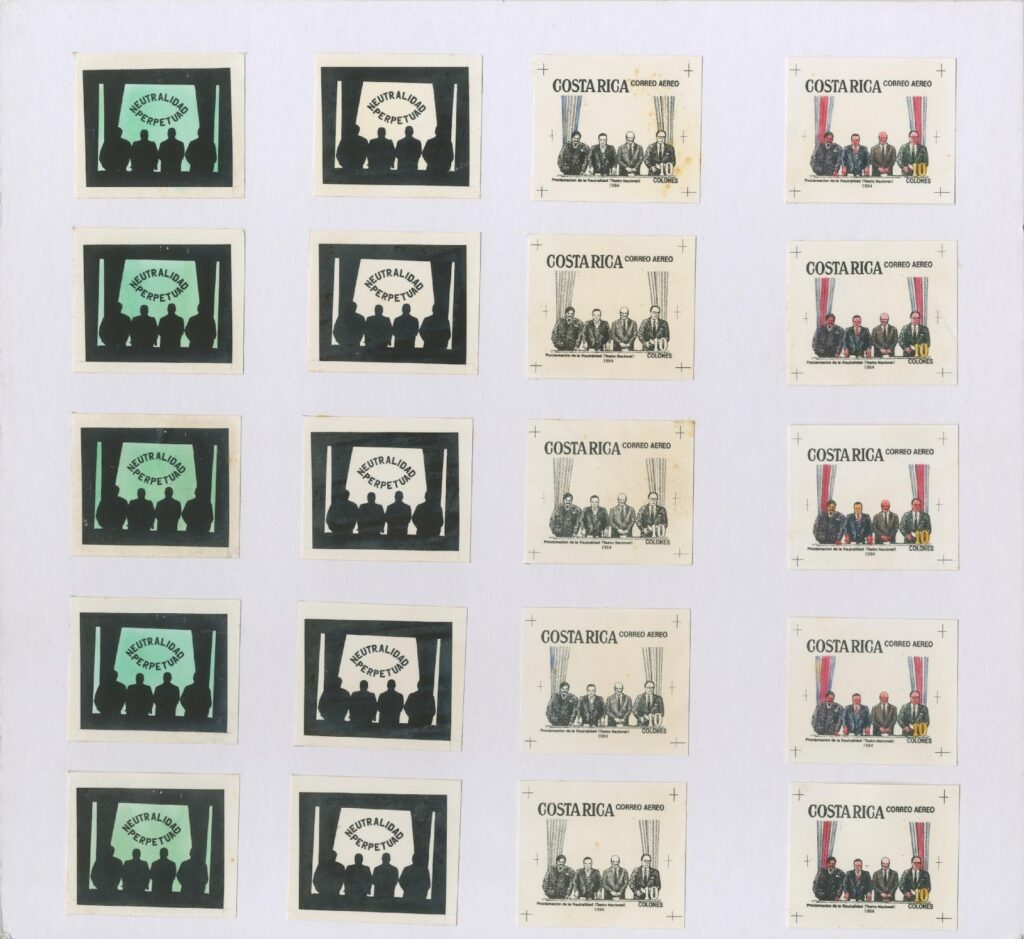
In 1984, an attempt was made to issue a series of stamps alluding to the first anniversary of the Proclamation.
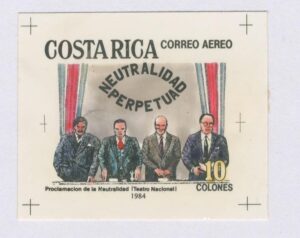
Two sheets containing a total of thirty positives survived this attempt, with proofs of drawings based on a photograph of Luis Alberto Monge with other officials, as well as various designs of the process of making the arts.
In February 1985, finally, a series of three values was issued, one of which is neutrality, but the sketches shown here were not used.