Fernán Pacheco (fernanpacheco@hotmail.com)
The bisected postage stamps of Costa Rica, particularly the half-real stamps of the first issue, constitute a very interesting and little studied chapter of our hobby. They are very scarce and, as expected, there are some of doubtful authenticity.
It has not been located and possibly never existed the legal disposition that authorized cutting the stamps diagonally or longitudinally, being rather a practice that occurred for reasons of necessity or mere tolerance. In this regard, Fred O'Neill, in his book “Costa Rica: Centennial of the First Postal Issue”, attributes the practice to the fact that many nations, especially the less developed ones, resorted to it due to the scarcity of low value stamps, which were the most consumed.
He also makes an interesting proposal in the sense that the origin could also be related to Resolution V of June 12, 1872, in fixing a rate of five cents for parcels of two ounces to one pound, and establishing that, as for printed matter and circulars, these would pay the rate at the discretion of the Postmaster General.
In this regard, he indicates that “it is quite possible that the administrators arranged to charge the sum of two and a half cents for the rate of correspondence classified as printed or circular, weighing no more than one ounce.”
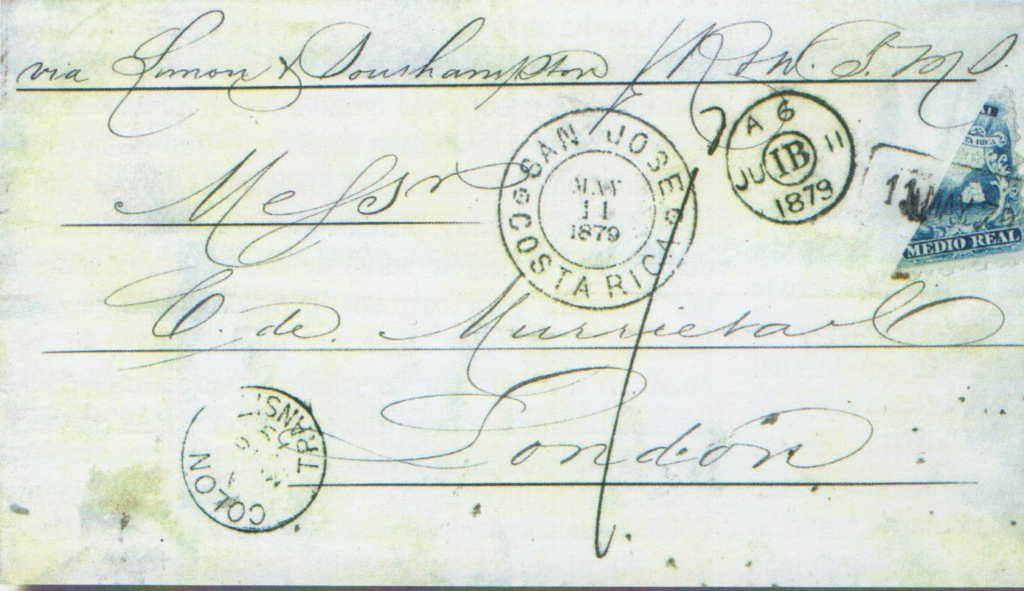
Even though -as indicated- there is no known legal provision authorizing this practice, there is one that puts an end to it, namely, Agreement No. 232 of December 4, 1883, which provides:
“It is absolutely forbidden, henceforth, to use stamps or cut timbres, and those applied in this form are invalid. “
Upon reviewing this provision, it caught my attention that tax stamps timbrewere also included. It is worth asking whether, unlike postage stamps, there was any regulation authorizing this practice. As on other occasions, upon scrutinizing the Collection of Laws, I found valuable information.
In fact, Decree No XV called “Regulations for the Use of the Timbre”, given at the Presidential Palace by Major General and Constitutional President Prospero Fernandez, on November 3, 1882, gives us the answer. Let us remember that only a few days before, on October 13, 1882, the so called “timbre tax” had been reestablished, which had been eliminated in 1870 after only three months of use, because it was considered that “...it was a tax that could not be used for the purpose of taxation".“the tax obstructs transactions and creates problems for the future with great damage to the property and the tranquility of the population; because they are easy to evade, they imperceptibly generate a germ of immorality and because the tax is more onerous for the poor than for the rich class.”as stated in the repealing law itself.
However, for the purposes of this note, the regulations stipulated that the timbres were to be canceled and affixed to the different types of documents. As for cancellation, it stipulated that it should be “killed with date and signature ”of the obligated party“. Curiously, it uses the term ”killed," which is still used today by tax collectors and users in general. As for how they should be affixed, depending on the type of document, so were the formalities: on domestic bills of exchange, affixed to it and with the signature of the drawer; on international bills, with the signature of the acceptor; on public deeds, affixed to the protocol with the signature of the grantors, and finally, “in bilateral contracts that are recorded in duplicate documents, the timbre shall be materially divided into two parts, so as to place one part in each document”.
Consequently, in bilateral contracts, which are those involving two parties and signed in duplicate, cutting the timbre in order to adhere half to each of the originals was not only mandatory but punishable by a heavy fine equivalent to ten percent of the value of the business, if not done in this way. This is the case of rental contracts that are signed in duplicate, one for the landlord, the other for the tenant.
And if you were expecting that I was going to embellish this note with a bisected fiscal timbre, I am afraid it will not be so: obtaining documents with fiscal timbres of the 1882 issue, is very difficult, but pretending to find the two originals of a contract, or at least one of them, with half of the timbre attached, looks like a very difficult mission, but, at least we have the certainty that they existed and that they were 100% legal.
